What an MCP server is, and why it matters
The Model Context Protocol is the standard way to connect an AI assistant to business tools and data. What it means in practice, and how to plan your first connections without mistakes.
Strategy · 3 min read
Off-the-shelf models are ready to use and powerful; a dedicated AI knows your company’s language better. How to choose, and why the best answer is often a combination of the two.
Any company introducing artificial intelligence soon faces a question: use the large models available on the market, or build something dedicated? The question is often framed too starkly, as if it meant choosing one path or the other for good.
In reality, the two options meet different needs, and understanding your own is the first step toward a sensible decision.
The models from the leading AI providers are excellent at understanding and producing language, can reason through complex problems and are constantly improving. They can be used right away, with no upfront investment in training, and cover a very wide range of tasks: writing, summarizing, translating, analyzing documents.
Their limits are just as clear. They know nothing about the company’s data, terminology or procedures. What’s more, the data you send is processed on the provider’s infrastructure, which needs careful consideration for confidential information or personal data, not least in light of the GDPR.
Off-the-shelf models
Custom AI
Custom AI can mean different things, and it helps to tell them apart. The most common form is not training a model from scratch but giving an existing model access to company knowledge: documents, procedures, data from business systems. The model itself is not changed; it simply receives the right context for each question.
A deeper form involves fine-tuning a model on the company’s documents and examples so that it learns its language, formats and rules. This approach pays off when tasks are highly specific and repetitive, for example classifying technical documents against an internal taxonomy or drafting texts in a strict house style.
Finally, a dedicated model can run on infrastructure chosen by the company, including a private one, when data residency requirements call for it.
Three questions help you find your bearings. The first is about data: how confidential is it, and where does it need to stay? The second is about the task: is it generic, like summarizing a document, or does it require very specific domain knowledge? The third is about volume: a task performed thousands of times a day may justify a smaller, dedicated model, while for occasional use an off-the-shelf model is almost always more cost-effective.
A common mistake is to start with the most ambitious solution. Training a model takes clean data, high-quality examples and time. Very often, an off-the-shelf model with access to the right documents solves the problem for a fraction of the investment.
Maintenance is also worth considering. A dedicated model has to be updated whenever procedures or products change, whereas an off-the-shelf model that reads up-to-date documents reflects the changes with no intervention at all. Costs, too, should be assessed over time, not just at launch.
In most cases, the best answer is a combination. Off-the-shelf models handle language and general reasoning, company knowledge provides the context, and a dedicated model is added for specific tasks or particularly sensitive data.
This architecture also has a strategic advantage: it doesn’t lock the company into a single vendor. The AI market is changing fast, and being able to swap one model for another without rebuilding connections and access rules protects the investment you have made.
Innovaq’s AI assistant is designed with exactly this in mind. It integrates with the leading AI services and, where needed, with custom models trained on the company’s own documents and procedures. The choice can vary from one task to the next, while the data connections, permissions and request log stay the same.
Keep reading
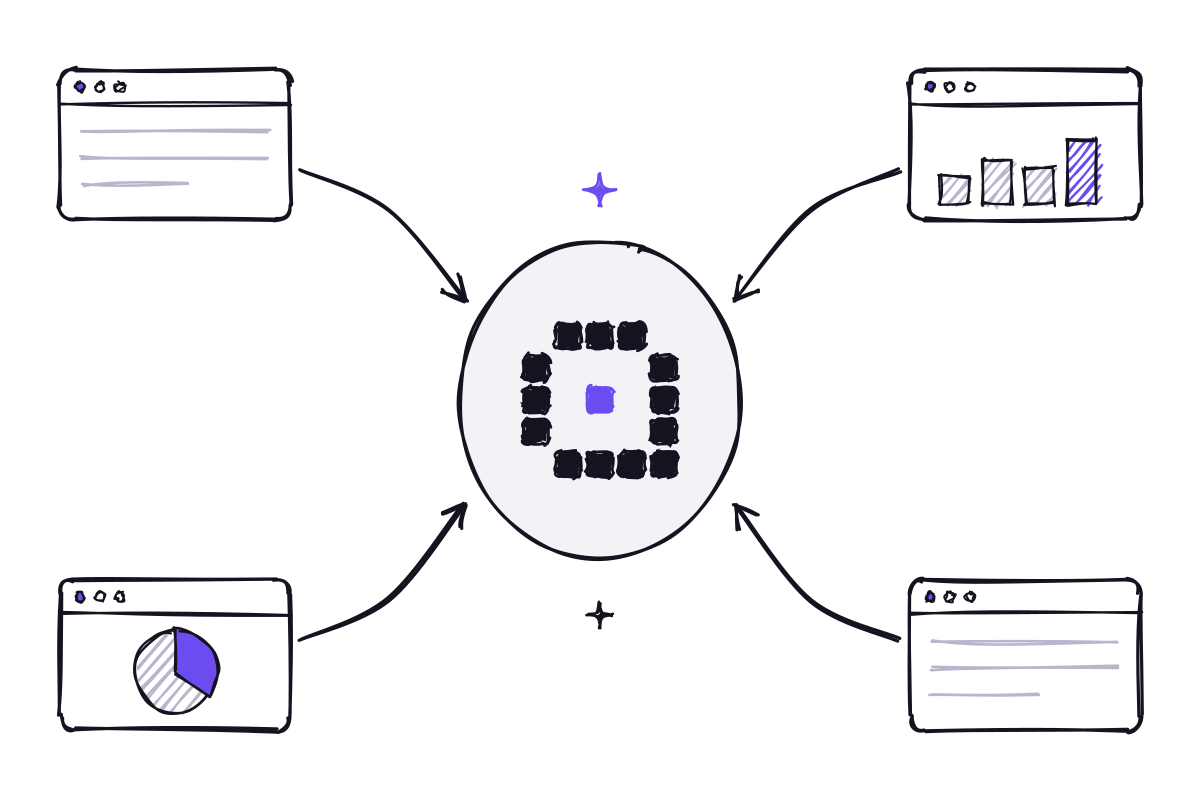
The Model Context Protocol is the standard way to connect an AI assistant to business tools and data. What it means in practice, and how to plan your first connections without mistakes.
AI-driven automation is only useful if you can trust it. The principle of AI that prepares and a user who confirms, and how to apply it when designing workflows.
Innovaq is a company in its launch phase.